
The real reason WMS projects fail (it's not the software)
By Bob C. Kennedy
Most companies treat a WMS selection like a software purchase. It isn’t. When you buy a WMS, you are choosing a business partner who also offers software — one who will be deeply embedded in your operation for the next 5 to 10 years. That perspective changes everything about how you run the process.
I’ve been part of more than 200 WMS implementations. The projects that fail don’t usually fail because the software was wrong. They fail because the vendor was wrong. Too many selection processes are laser-focused on features and functions. Every serious WMS vendor can move a box through a distribution center. What separates a good outcome from a bad one is the people behind the software — their support model, their culture, and how they respond when something goes sideways.
Here are some tips on how to run a WMS selection process that you won't have to do again in three years:
1. Start before you talk to vendors.
Before you contact a single vendor, do two things.
First, define your real business requirements. This sounds obvious, but it isn’t. There’s a difference between what your business needs and how you do things today. Many projects fail because companies try to make new software fit the old process. Define what you need the system to accomplish, not how you currently accomplish it. When in doubt, change the process — not the software.
Second, get your data in order. Pull your order history, SKU profiles, and receipt and return data. Build an operational profile. Bad data is the hidden killer of WMS implementations. Identify the gaps now, before they become problems during go-live.
2. Come up with the right vendor list.
With your requirements in hand, research the market before sending a single RFP. A typical shortlist runs five to six vendors. To get there, answer two questions up front:
Are you looking for a best-of-breed WMS or a module within your existing ERP platform?
What tier fits your operation — large and complex (Tier 1), moderately complex (Tier 2), or smaller and primarily inventory-focused (Tier 3)?
Those two answers cut the list dramatically.
3. Build your RFP like a two-part exam.
Think of your RFP as a college exam. There is a multiple-choice section and an essay section.
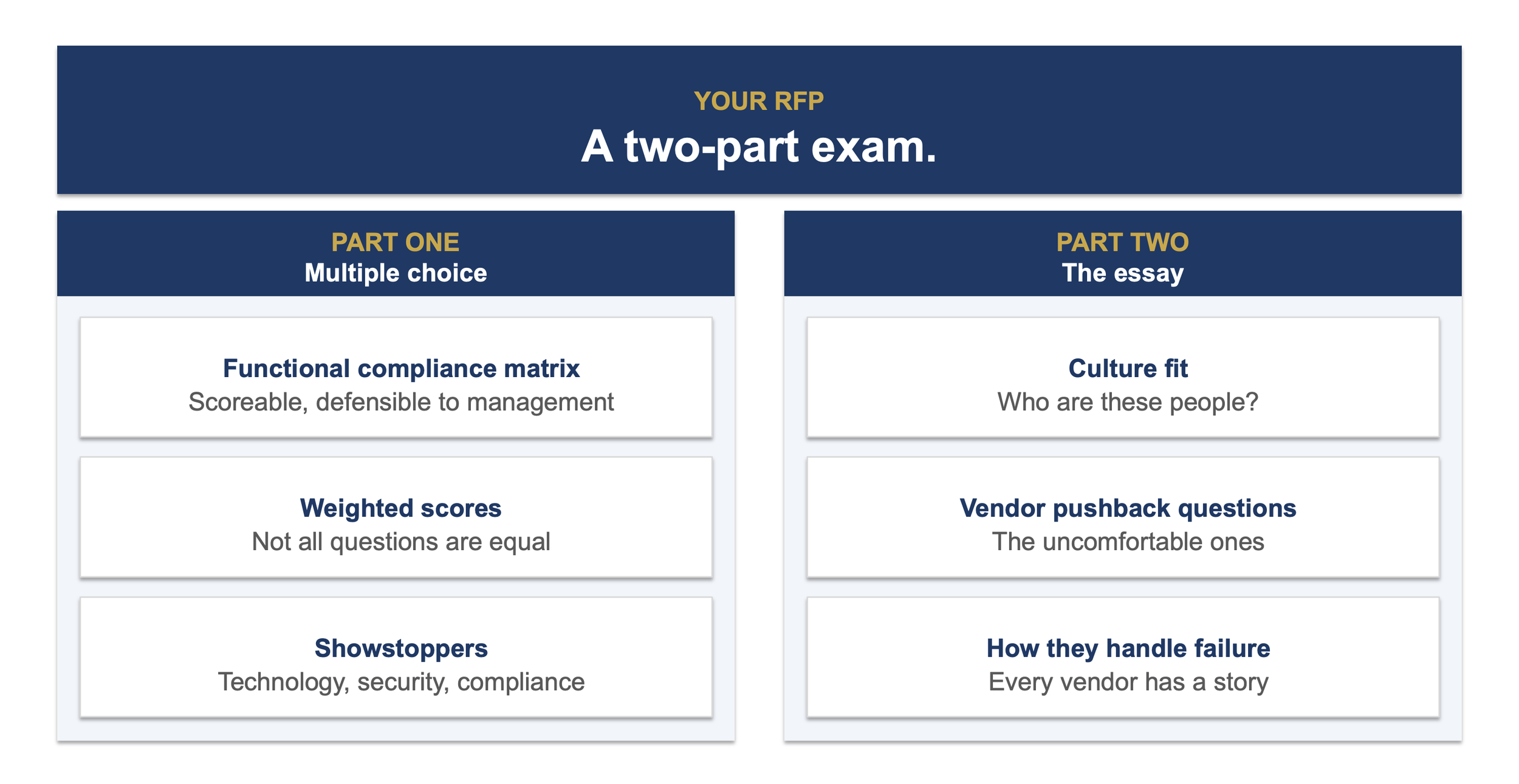
The multiple-choice section is your functional compliance matrix. It levels the playing field, gives every vendor the same questions, and produces a score you can defend to management. It’s important. But it doesn’t tell you everything. Not all questions are equal. Every question should be weighted regarding its importance to your business. Some are critical — “showstoppers” if you will. And often the critical factors have nothing to do with functionality but with technology, architecture, security and compliance.
The essay is where you find out who the vendor actually is. Ask the uncomfortable questions. How would they handle a non-cooperative member of your project team? How do they react to “the customer is always right”? What’s the biggest disruption they see coming to their market in the next five years? The more uncomfortable the question, the better the insight. You’re not just evaluating what they sell. You’re evaluating whether you want to spend the next decade with these people.
Score both parts. Qualitative responses aren’t a footnote — they carry real weight.
4. Don’t let due diligence become optional.
Once you’ve narrowed to three finalists, go deeper.
Run structured demos that evaluate not just features, but ease of use. Check references — and don’t settle for the easy questions. Ask where the vendor failed and how they recovered. Ask about a project that went sideways. Every vendor has one. What matters is what they did about it.
Visit a customer site. Talk to the users without the vendor in the room. Most vendors will expect this and won’t object. What you hear in that conversation is worth the cost of the trip.
5. Make the final decision carefully.
Combine your quantitative scores with your qualitative judgment and make the decision as a group. When you notify your selected vendor, make it conditional on contract execution. And keep the second-place vendor in play. That leverage matters more than most people realize.
One last thing. When your vendor pushes back on something you’ve asked for, pay attention. That’s not a red flag — that’s the sign of a good partner. A vendor who does WMS for a living has been through this process many times before. The last thing you need is someone who accepts every requirement without question and sends you the bill.
Listen to them. That’s why you hired them.
RC Kennedy Consulting can help.
At RC Kennedy Consulting, we’ve guided companies through this process more times than we can count — from defining requirements and building vendor shortlists, to running the RFP, facilitating demos, and negotiating the final contract. Our team brings decades of hands-on WMS experience, proven tools, and no agenda other than getting you to the right decision. If you’re starting a WMS evaluation or aren’t sure where to begin, reach out. We’re happy to start with a conversation.