
Picking smarter, not harder
By Bob C. Kennedy
At hour seven of a shift, your picker may be exhausted. They’ve zigzagged across the warehouse hundreds of times. They’ve put miles or steps in. They grab the wrong SKU. Or they grab the wrong count. When people are tired, accidents are also more common.
How do you address these common situations? Most warehouse managers know something is off long before they can name it. Here are some things to look for:
First, what percentage of time are your pickers spending traveling versus actively picking? How many times does a picker visit and revisit a pick location during a single day? Is your workforce constantly traveling back to locations, especially the ones holding fast-moving items? How much time is spent waiting on replenishments or other order components? Is your workforce hunting for items that aren’t where they’re supposed to be?
When these numbers are high, your operation is working hard but not smart.
The numbers alone don’t tell you what to fix. That depends on your order profile: how many lines, how many units, and what mix of large and small orders you process on any given day.
Start With Your Order Profile
In almost every warehouse I’ve worked in, velocity follows a pareto profile, meaning a small percentage of items drives the vast majority of picks. In distribution, that often looks like 20% of your items accounting for 80% of your picks. Any strategy aimed at reducing travel must reflect that reality or you’re solving the wrong problem.
At the large order end of the spectrum, one person picking an order complete may mean traversing the entire warehouse. At the other end, high volumes of small orders with fast-moving line items mean your picker visits the same locations over and over all day long if you’re picking them complete one at a time.
These two profiles need different solutions.
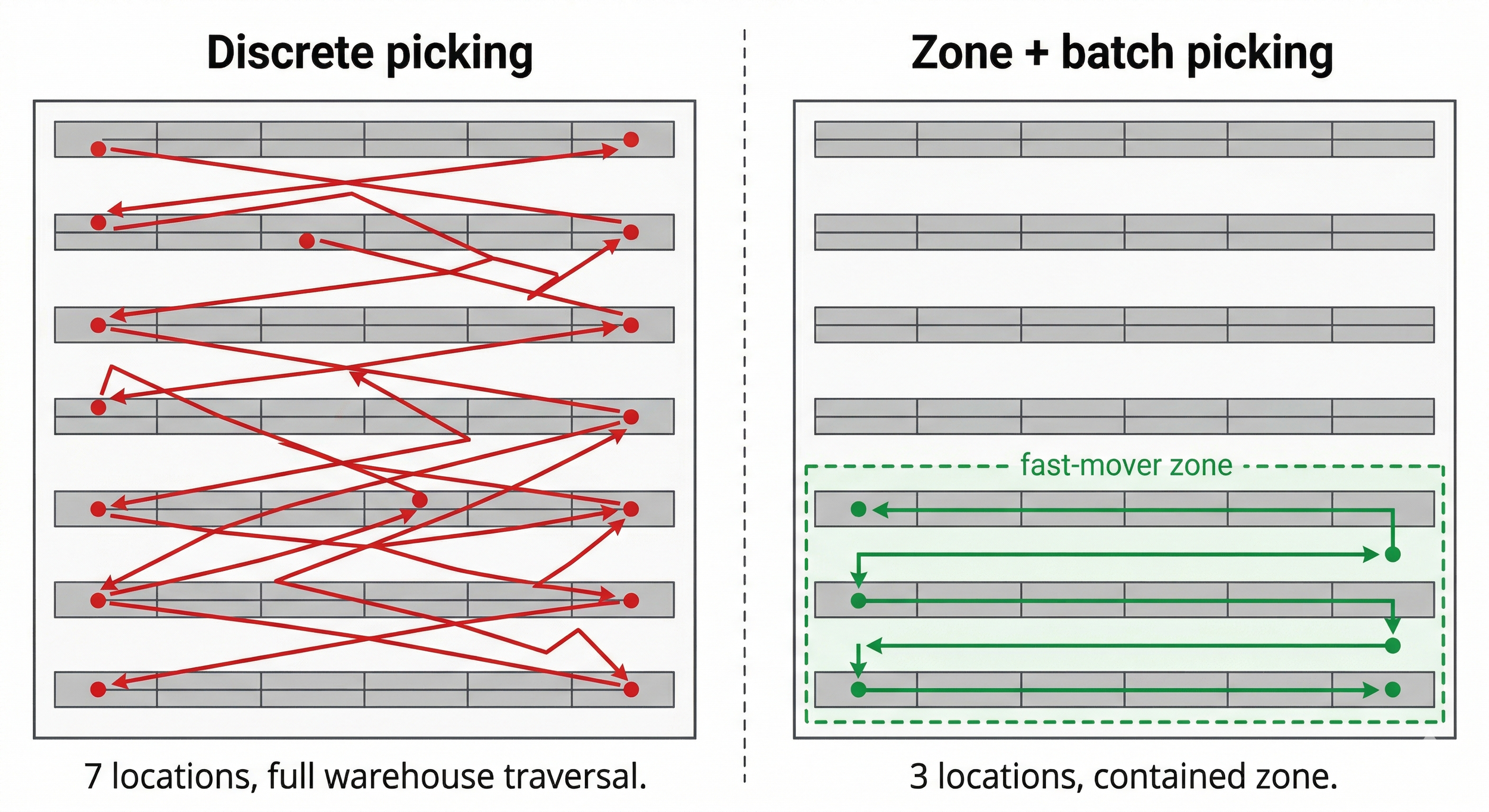
For large orders, consider zone picking where multiple people pick order components simultaneously within their zones, or a pick and pass scheme where an order moves through zones in sequence.
For smaller orders, batch or cluster picking is the answer. Group orders that share SKUs and pick them together. Instead of visiting a location ten times for ten separate orders, you visit it once and pull for all ten.
Key to these strategies: keep your workforce picking in their areas and zones, not transporting orders long distances.
Before you commit to either approach, settle two questions early. Do you have justification for automating how order components are transported around the building? And how will you consolidate order components to ship orders complete? Companies that skip these questions during planning pay for it later.
Ask Your Workforce First
Your pickers know when they’re working hard but not smart. They feel it by midday. And consider that pickers likely represent the largest group in your total workforce, especially in piece pick operations. Reducing their travel is one of the highest leverage moves you can make for morale, safety, and productivity at the same time.
Before you bring in outside help, ask your workforce what they’d change. They WILL have ideas. Good ones. In my experience, the people doing the work have already identified most of the problems.
Where Most Operations Get Stuck
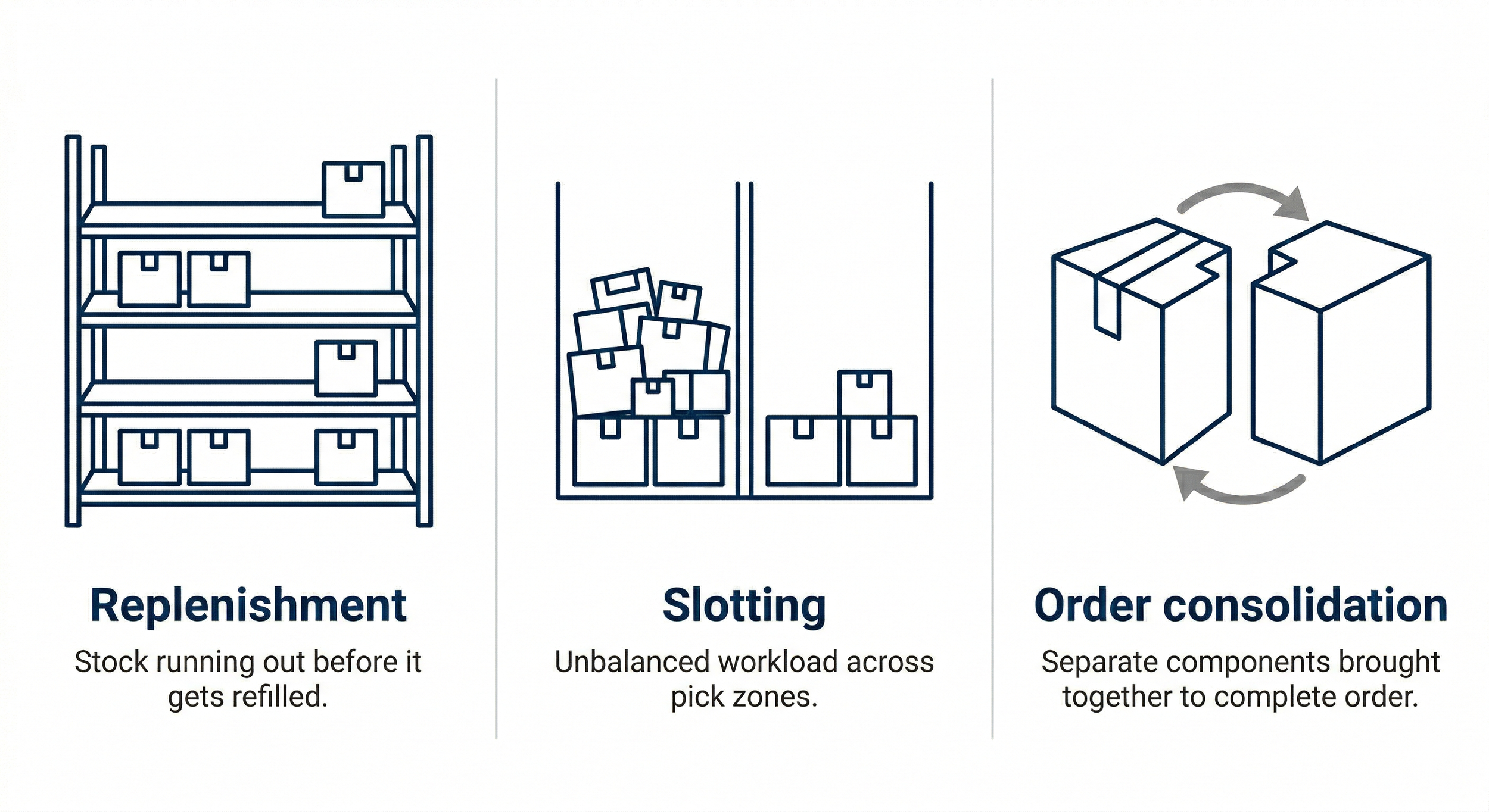
Pull your fast movers into a concentrated, replenished pickline and you minimize travel dramatically. But three challenges come with it.
Replenishment. A concentrated pickline holds less inventory. Stock runs out faster. You need replenishment triggered before a location goes empty, not after. If that isn’t managed proactively, your pickline becomes a bottleneck.
Slotting. You can’t put all your fast movers front and center or your workforce ends up competing for the same locations. Pick zones need to be balanced by workload. As businesses are often very dynamic, it is common that today’s fast movers will not be the same tomorrow. When I see warehouses struggling with zone imbalance, it’s almost never because they didn’t understand the concept. It’s because they set it up once and never revisited it.
Order consolidation. When you split picking across zones or multiple pickers, those components need to come back together before they ship. Getting this wrong means faster picking that still results in late, incomplete, or mis-shipped orders. The pick strategy and the consolidation strategy must be designed together.
What to Demand from Your WMS
A Warehouse Management System (WMS) will sequence orders to minimize travel and, with a mobile device, will guide pickers through each pick trip, ensuring better accuracy and productivity. This capability turns your operation from one that is strictly reactive to the workload into one where you get to determine how you want things to run, balancing efficiency with service performance.
But technology is only as good as the operation it’s built on. The system matters. The implementation and the ongoing discipline matter more.
Your pickers already know something needs to change. The strategies to fix it are proven. The question is whether your operation is set up to sustain them.
Not sure where your operation stands? Take our five-minute self-assessment and find out. Or if you’d rather talk it through, book a free consultation.