
Replenishment: The picking strategy you forgot to plan for
By Bob C. Kennedy
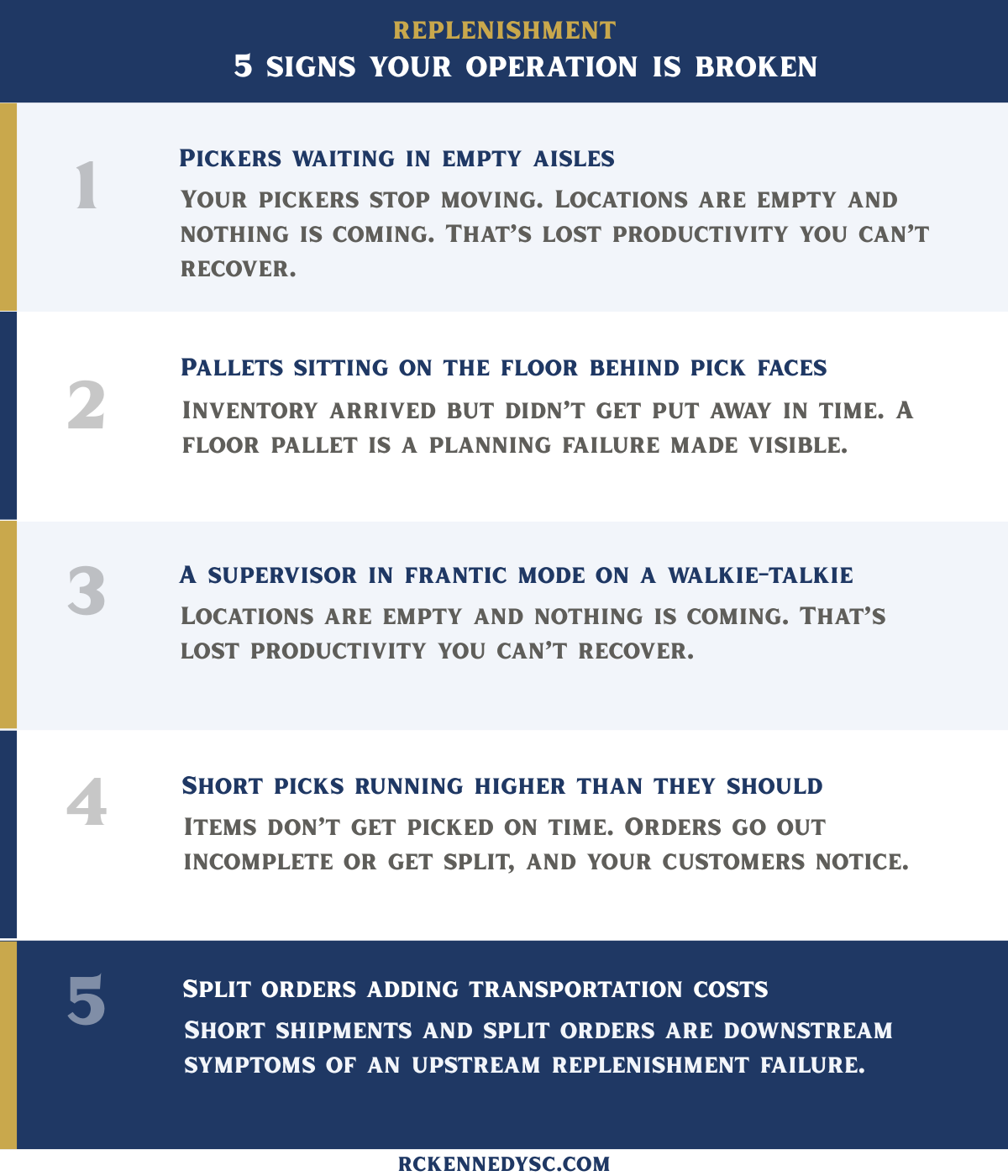
Walk into a warehouse where replenishment is broken and you’ll know it immediately. Pickers are standing in the aisles in front of empty locations, waiting. Pallets are sitting on the floor behind the pick face because the timing is off. A supervisor is in frantic mode on a walkie-talkie or phone trying to expedite a replenishment that should have happened an hour ago. And when you pull the numbers, short picks are running higher than they should be.
This is more common than most people want to admit. In my experience, it's almost always a planning problem, not a software problem.
Replenishment gets treated as an afterthought in warehouse design. Companies spend a lot of energy thinking about how to pick and not nearly enough thinking about what happens when the pick location runs out. The result is an operation that works fine in theory and falls apart under real volume.
Why it happens
The logic behind a concentrated pickline is sound. If 80% of your product movement comes from 20% of your items — and it almost always does — it makes sense to pull those fast movers into a smaller, concentrated area, so your pickers aren’t traveling all over the building to complete an order. Less travel means better productivity.
The catch is that by concentrating inventory into a smaller space, you can only hold so much of it at the pick face at one time. The faster an item moves, the faster that space empties out. Which means somebody has to keep refilling it. If replenishment can’t keep up with the pace of picking, the whole operation bogs down.
And here’s the thing about fast movers: the faster an item moves, the more space it needs at the pick face. Otherwise you end up dedicating a replenishment person to just a handful of items, running back and forth all day. We'll get into how to right-size that in Part 2.
Two types of replenishment — and why the difference matters
Most WMS systems support replenishment in some form, though the capability varies considerably. There are two approaches.
On-demand replenishment means the system monitors inventory levels in real time and generates a replenishment task the moment stock hits a defined trigger point. Good WMS systems go further — they assign priorities to those tasks and update them dynamically based on conditions on the floor, so the most urgent replenishments get done first.
Planned replenishment, sometimes called top-off, works differently. Rather than reacting to real-time depletion, the system looks at inventory levels in locations and creates tasks to refill them — typically run off-hours, overnight. It’s not tied to what’s happening on the floor at any given moment. Some operations use both: planned replenishment handles the overnight reset while on-demand handles what comes up during the day.
More often than not, the operations I walk into have some version of replenishment capability in their system. But rudimentary is the right word for it. It’s not tied to what’s actually happening on the floor. It can’t prioritize. It can’t anticipate. In practice, somebody is watching the pickline and making judgment calls — and hoping they get there before the picker does. That's where the walkie-talkie comes in.
What it costs you
Putting hard numbers on the productivity impact is difficult because every operation is different. But the mechanics are straightforward. When a replenishment doesn’t happen on time, you have two bad options: pickers wait at the empty location, or they skip it, finish the rest of their picks, and circle back later. Both add travel. Both hit productivity.
The order-level impact is just as real. Items that don’t get picked on time either get short shipped or go out separately, contributing to transportation costs and customer service issues. Short shipments and split orders are downstream symptoms of an upstream replenishment failure.
What good looks like
When replenishment is working, pickers don’t wait. Locations refill before they empty. Nobody’s running around on a walkie-talkie. The trigger point is set correctly — high enough that there’s always enough stock to cover active picks until the replenishment arrives.
Adjusting your trigger point is the quickest fix — that takes about 30 seconds and can change things immediately. But the real work is right-sizing the pickline so that replenishment stays manageable without holding excess inventory at the face. That, as I like to say, is the Holy Grail of picking operations.
We’ll get into how to find it in Part 2.
Replenishment problems don't fix themselves. RC Kennedy Consulting can walk through your operation, find where the breakdowns are happening, and build a plan to fix them. In a consultation, we'll also cover how to evaluate WMS vendors — including the questions most companies forget to ask. Reach out to start a conversation.