
Designing warehouse flow that moves at the speed of your business
By Bob C. Kennedy
When warehouse performance starts to slip, most leadership teams look first to insufficient or ineffective labor. Recruiting, training, and retaining qualified employees long-term has become increasingly difficult. Seasonal demand further complicates the issue, often requiring temporary labor with uneven results.
I have spent decades inside distribution centers — redesigning operations, implementing systems, and helping organizations recover from costly inefficiencies. What I have discovered is that most warehouses don’t just have a labor problem. Most operations, even automated operations, can do a better job designing their flow. And often, they can do so without the need to invest significant capital and time.
What Makes a High-Performing Warehouse?
What separates a high-performing warehouse from an average one frequently comes down to the manual intervention required just to get through a normal day. In underperforming operations, people spend too much time doing unproductive things — searching for putaway locations, looking for misplaced pallets, waiting on replenishments, and manually correcting inventory discrepancies or other errors.
When inventory systems lack discipline, or when standard operating procedures aren’t consistently followed, companies tend to compensate the only way they know how: they add people. I have seen plenty of operations with dedicated, full-time employees solely assigned to managing inventory—work that should be directed by a properly configured and enforced warehouse management system.
Even highly automated facilities struggle to meet their original promises. But automation doesn’t automatically create flow. If the process isn’t designed with a holistic approach (we’ll talk more about that later…) automation often will just move the bottleneck, creating new problems upstream or downstream.
Flow Failure: Signs and Symptoms
Each area of the operation has its unique flow challenges. Here’s where I most commonly see breakdowns:
Picking
Easily the most labor-intensive and the most transaction-heavy part of the operation, picking is where there is the most potential for things to go wrong. When picking falters, the effects ripple outward — delayed replenishment, longer order cycle times, missed ship windows, inventory problems, and ultimately, unhappy customers.
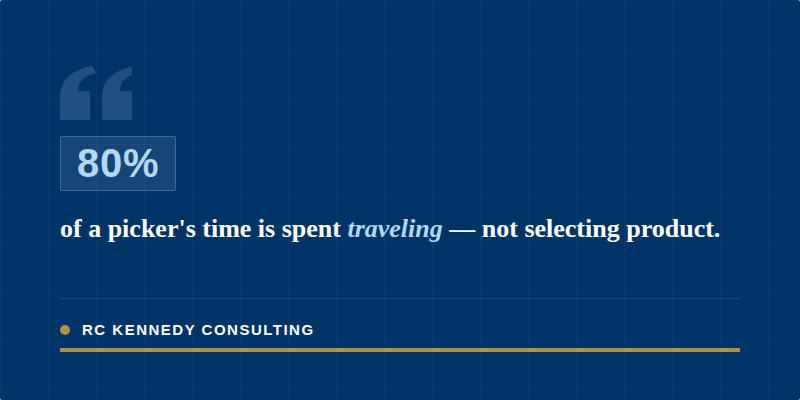
Pick operations hold increased opportunities for hidden inefficiencies. In many manual facilities, as much as 80 percent of a picker’s time is spent traveling rather than actually selecting a product. That means only a fraction of paid labor time is spent performing value-added activity.
With better slotting strategies, optimized pick sequencing, and disciplined system execution, that travel time can often be reduced dramatically. Yet I still encounter facilities where a single associate is assigned to pick an entire order from start to finish, walking the full length of the warehouse — sometimes entering temperature-controlled rooms, hazmat areas, or repeatedly climbing stairs. It’s more common than people think, and it’s expensive.
Automation
The most costly operational errors typically involve the use of automation. One of the most common issues I see is “spot automation” — for instance, where a company invests heavily in automating picking, dramatically increasing throughput in that function, only to discover that packing or shipping cannot keep up. What was once a picking constraint becomes a downstream bottleneck.
Then again, I’ve also seen operations where an automated system is installed to handle the heaviest work and initially performs well because it was properly sized for that moment in time. Gradually though, the system cannot keep pace with changes and growth and eventually ends up handling just the opposite – the slowest movers.
It’s a tough lesson to learn: if you don’t keep revisiting your operation’s flow design, yesterday’s solution becomes today’s problem.
Warehouse Space
Warehouse systems need, at a minimum, 10 percent of empty space to work properly. Too often warehouses are filled to the brim and the operation bogs down. When space disappears, staging areas overflow, pallets end up in aisles, and inventory is stored wherever it fits. Productivity drops and errors increase.
How can you catch warning signs of flow failure before they happen? I always tell people: observe the floor. Look for dirty, dusty floors. Look for pallets where they don’t belong — in aisles, along walls, stacked on top of each other. These are telltale signs that the warehouse has not only run out of space but has become a challenge to manage, resulting in less productivity, increased travel and searching time, and higher errors.
A Holistic Approach
Here’s a caveat about detecting symptoms of poor flow: you can’t fixate on one issue. It’s so important to evaluate operational flow holistically rather than address isolated symptoms. You can’t just try to solve a picking problem, or an inventory problem. You have to apply the best practices, systems, and the correct automation to the total operational system to create the greatest impact.
Take a manual warehouse with rudimentary systems and no automation. Our team of consultants would focus on a holistic redesign: creating an information hub with a warehouse management system, standardizing processes, and installing the right size and type of automation.
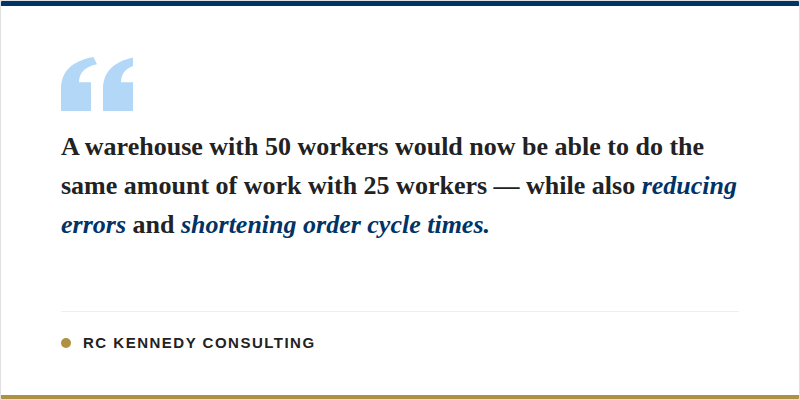
With all of this, we would see (and have seen) improvements in productivity upwards of 50 percent. That means that prior to the improvements, a warehouse with 50 workers would now be able to do the same amount of work with 25 workers — while also reducing errors, improving inventory accuracy, reducing backorders, and shortening order cycle times.
Labor shortages and capacity constraints are real, but they are often symptoms of deeper design issues. Sustainable performance comes from aligning systems, space, processes, and automation so product flows efficiently from receiving to shipping.
Fix the flow—everything else gets easier after that.

Bob C. Kennedy
For more than 40 years, Bob Kennedy has planned, developed, and implemented industry-leading supply chain execution systems around the globe. Bob and his staff have led more than 200 large-scale implementations of supply chain execution software for leading customers in a variety of industries, including Johnson & Johnson, Penguin Random House, DHL, and Google.